
Discernment.
How judgement reshaped my work, my life, and my learning.

Discernment: (noun) the ability to judge well.
2025 has been an incredibly successful year for me, and I credit it entirely to a newfound appreciation and awareness for my discernment. In 2026 I’m taking that discernment to the next level, taking inspiration from the way I conduct business to be more intentional around what I do outside my grown-up obligations in order to feel more fulfilled in my personal endeavours and achievements.
This article outlines how I rediscovered the power of exercising discernment, why discernment has paved the way for more business success, how I realised it was missing from my personal endeavours in 2025, and the full system I’ve re-implemented to support my personal goals, interests and projects in 2026 so you can too.
It seemed to start with dumping my boyfriend.
An exercise of discernment, in 2024, when I decided I simply was not being treated well enough; a culmination of my standards and expectations being repeatedly unmet.
A lack of discernment, allowing it to continue as long as it did.
Buried somewhere deep within me, shushed in the name of “he deserves a second chance”, my discernment reignited in that moment and has been on fire ever since, with a level of awareness and appreciation I’d not had before.
That one moment of discernment transformed me from scared, miserable and overly-compromising, to excited, energetic and unflinching within 24 hours.
With a whole lot more bandwidth to be able to think and reflect, it didn’t take me long to realise my discernment had been completely absent from my personal life for some time - and possibly even dulled in my professional life.
I vowed never to compromise my standards and expectations of myself or anyone else again, and to remain discerning to the level I always had been up until that relationship; the level I was worthy of.
Within months of that break-up, I’d added $130,000 ARR to my consulting business, learned Bach’s Toccata in D Minor on the pipe organ, played it for an audience in the Auckland Town Hall, had a month-long holiday around Europe, been appointed a Trustee of the Auckland Town Hall Organ Trust, and met the (actual) man of my dreams - who holds the same high standards as me - via an Instagram DM after he saw me at a set of traffic lights. There’s a lot more to that story, but I’ll save it for another day article.
How discernment shaped my business in 2025
In business, discernment creates space, and the ability for you to achieve more, with less. The same goes for life, though that may be less about achievement, and that’s OK.
In business, you can be discerning in who you choose to work with, what services you offer, or when you may or may not be available to take calls or respond to messages.
At the end of Q2, I stopped writing my LinkedIn newsletter, which had soared in popularity to over 5,000 subscribers in a matter of months. I had enjoyed it, but felt it had become aimless, impersonal, and of little more value to readers than my day-to-day LinkedIn content - all factors. I decided I’d rather explore building a Substack publication, and doing both would reflect a lack of rationale; a lack of discernment - so the newsletter stopped.
At the end of Q3, I got a new cell phone. I purposely did not put any “work” apps on it - no email, no LinkedIn et cetera. As a result, I spent less time on both, with no negative impact to my work and probably only a positive impact to my life overall - nice by-products of discernment.
At the end of Q4, I paused one of the services I was previously offering in my consulting business, which immediately felt like a weight off my shoulders but also has enabled my team and I to design a more targeted marketing strategy next year.
Those are the major-ish moments of discernment I feel have shaped/are shaping the trajectory of my business in 2026 and beyond.
Planning business & life with discernment
Historically, I have planned out my professional and business objectives more or less according to a planning methodology I’ve designed over many years, during which I’ve become increasingly aware of the systems and structures I (/humans?) need in order to be conscientious around subjects and tasks that don’t necessarily interest me (/us) deeply.
As a teenager and young adult, we’re generally afforded more bias towards the topics and fields we’re interested in. At school, we choose subjects. If we’re fortunate, we also choose our extracurricular activities, be it a sport, artistic discipline or some other hobby, or all of the above. Our lives are largely devoid of broader responsibilities, then at college or university, we also choose subjects and activities and, if we’re lucky, our lives are still relatively devoid of those broader “adult” responsibilities. It isn’t until we enter the workforce or move out of home that we find ourselves spending more and more time on tasks that are merely mandatory, and not driven by interest or passion at all.
With conflicting priorities tussling for our time and attention, it’s at some point following that transition to adulthood we must make conscious choices to set aside time for what does interest us, or as I like to say, what “tickles my fancy”. And if we don’t, any “spare” time (beyond rest) fills up without intention or discernment.
My planning methodology has been both a blessing and a curse. A blessing, because at 36 I now have multiple businesses, clients, trusts and investments that demand a decent portion of my time and attention. A curse, because at 36 I now have multiple businesses, clients, trusts and investments that demand a decent portion of my time and attention.
The reason it works so well is because it forces conscious discernment between what one will and won’t be doing. But because it works so well, this means I need to be careful to also curate the time that’s left.
From reflecting on 2025 I’ve concluded too much of my time outside business and those other commitments mentioned above was spent passively or reactively. This is necessary to an extent, of course, but too much of one’s time spent passively or reactively results in a lack of fulfilment, at best. And I can honestly admit I wasn’t discerning enough around what I did in that time, particularly during the latter half of 2025. (The Giardia Chronicles go some way to explaining this.)
Life will always happen in ways that derail what we have planned. But much of the time, life (hopefully) won’t happen like that, and if we don’t have anything planned, the gaps will fill themselves with *whatever*. I don’t know about you, but I don’t really want my life to be filled with *whatever*. A little bit of *whatever* is nice. But there’s too much I’m interested in, too many things I enjoy - too much that tickles my fancy - and too little time in this physical life to not intentionally make room and plans for those! One must discern, judge, decide, refine, to fill one’s life with joy beyond that which naturally occurs or is simply stumbled into by happy coincidence.
Where did the wheels fall off?
Up until 2021 I’d used the same planning methodology I used in business, to also manage my personal goals. Essentially, it whittles down three annual objectives into monthly and weekly actions that have been qualified as genuinely important in the pursuit of those objectives. Having gone through that process, the meaning and motivation to execute any of those actions that aren’t particularly engrossing or interesting comes from the unequivocal knowing they’re needed. As a result, it feels incredibly fulfilling in the moment as one progresses through the sometimes-drudgery; inching palpably closer to the desired outcomes.
Since the end of 2021, I’ve written all my more personal goals across 8 areas of my life in a journal each New Year’s Eve, the last of course being at the end of 2024, for ticking off in 2025. Those areas are Career, Finance, Health, Relationships, Self & Spiritual, Family, Fun/Events, and Hobbies.
I was too distracted in 2022, 2023 and 2024 with endometriosis surgery, a growing business, a new business and a draining relationship to reflect on my personal goals anymore than beyond “did I achieve them?”, so I didn’t spot a problem until now.
And you could say there is no problem. I had achieved every goal except, ironically, two in the Career domain. There were 18 check marks on the page! I’d achieved EIGHTEEN (!!) of twenty goals!
But I was lacking fulfilment in 2025. And that should be deeply concerning to me, and is deeply concerning to me, having achieved 18 of 20 goals. To me, a fulfilled life is a rich life, and I think you will find many respected philosophers and modern-age self-help gurus alike, would agree.
This approach to my personal goals, I’ve realised having now consciously reflected on it, is more “aspirational” and more like “intention-setting” or manifestation than goal-setting. Typically, I write them down within 10 or 15 minutes - the idea is to spill out what my gut is telling me, without overthinking, onto one page - and then only look at that page in my journal a couple of times during the year. (This year I looked twice, aside from the other day.)
So, I was lacking fulfilment from inadvertently carrying out some of 2025 too passively or reactively, because my new “intention-setting” method of achieving personal goals required little more than writing them down.
I’d created a new and simpler system that subsequently created gaps in my time I therefore hadn’t planned to fill using the extreme discernment I had in the past.
I mean, it’s kind of cool, right? I somehow created a new system for myself that essentially makes the pursuit of my goals more efficient.
But efficient does not equal fulfilling!
My conclusion? The level of fulfilment was largely incongruent to the level of tangible achievements because this method of “intention-setting” eliminated the conscious attention from taking the steps towards them that comes from meticulous planning. We’ve all heard the “it’s about the journey, not the destination” trope, and it is indeed true.
This left me with an important question:
If the objective for 2026 is to feel a level of fulfilment directly correlating to my personal achievements, but the intention-setting already works for actually achieving them, how do I proceed without disrupting that achievement process?
Enter: The learning curriculum
The answer, I decided pretty quickly, is to somehow enrichen the pursuit of my various personal achievements - and perhaps raise the stakes a bit.
As a lifelong instrumentalist, I suspected this would mean incorporating more active learning into my life, having already derived a significant of fulfilment across extended periods in my life through learning to play the piano, guitar and saxophone, and knowing this learning process to be one of my “happy places”.
I was partly able to validate this swiftly, retrospectively, and with relevance to my life now, through my reintroduction to consistent musical learning over the last two years, i.e. taking up the pipe organ and having gone through the pain fulfilment of learning to the point of being able to play publicly. This also raised the stakes - the pipe organ is really hard to learn - and therefore it raised the reward. I don’t mind admitting I like the reward!
Some weird reverse-validation (?) came into play when I was pondering the answer to my question, too. One of the other things I actively enjoy doing is reading; mostly books, sometimes articles or short essays. But this is virtually always without a targeted outcome in mind.
As a result of all this, I’ve decided to enrichen the pursuit of my personal achievements by identifying relevant areas of interest and learning in support of them, and applying the same level of discernment I apply to my business objectives, to designing and planning the curriculum of information I’ll consume next year.
I will also be challenging myself to stretch my thinking on what I might accomplish in 2026 - after all, ticking off 90% of my goals in 2025 was easy, so by arming myself with additional learning, surely I can only accomplish more whilst also meeting the objective of increasing personal fulfilment along the way?
Time will tell! But…
I will need to be discerning.
My 2026 learning curriculum and system
I’ve landed on four areas of learning I’ll be focusing on in 2026. They are:
Discernment in Life & Business (for obvious reasons)
New Zealand Art History
Psychological & Mathematical Theorems, specifically:
Weber’s Law
Fechner’s Law
Stevens’s Power Law
Gestalt Principles
Helmholtz’s Theory of Unconscious Reference
Hick’s Law
Signal Detection Theory
Scalar Expectancy Theory
Attentional Gate Model
Size–Number Congruency Effect
Psychophysical Risk Theory
Gut Health & Health Optimisation
These all feed into or compliment personal goals of mine to varying degrees, and once I’ve finished fleshing out all of the learning materials, I plan on writing another article going into the full details of why I chose these topics, what the learning materials are and what I expect to get out of them.
I’ll still take the journal approach for the 8 categories on New Year’s Eve, but all this digestion of information will be planned out as meticulously as my business objectives have been, using a modified version of my Trello planning board. So far, it looks like this:
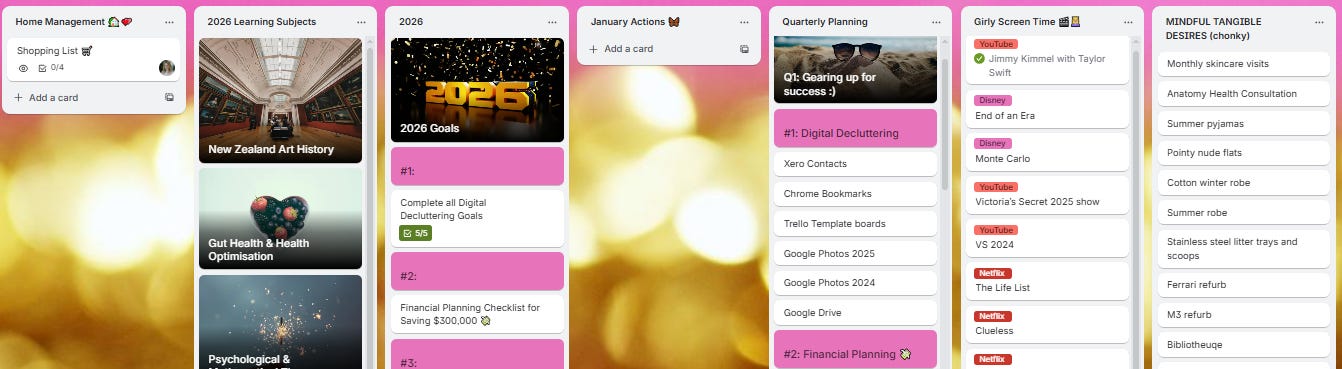
Partly redacted for privacy, this Trello Board includes everything “personal” about my life, from my grocery shopping list, to my learning curriculum, significant annual projects/objectives and shopping wish lists, broken down into quarterly actions pertaining to each project/objective. I don’t want tons of Trello Boards; I just want one personal one that has everything, with everything being nothing more and nothing less than what I need or is relevant. How very discerning of me.
I will probably set up a duplicate quarterly planning list to house the breakdown of my learning materials, so I know exactly what I’ll be reading, how much of it and when. Whenever I have, I’ll share it in my full curriculum article which I’ll link here when complete.
In the spirit of discernment as it pertains to the information I consume, I also have kept a running list of various shows, movies and documentaries I’d like to watch some day for the last few years. As part of tidying up this board, I went through the list as it stood and deleted anything I no longer felt I’d want to watch, looked up where I’d be able to watch the remaining ones, and labelled them, so when I feel like some mental checking-out time or curling up for a bit of rest on a day or evening off, I can grab something from this list and be really excited to watch it, knowing I’m doing so with intention. I already did this in 2025, but not quite to this level of organisation.
As a side note, my man often tells me I don’t “treat myself” enough, so this Trello board now contains two wish lists - one of things under $100 or so, and one of things with no price limit. Again, these were one pre-existing list I’ve culled but split into two lists for clarity and to aid decision-making. To ensure I consistently but mindfully indulge in some of the things I want (or even need, in some cases) I’ll review the lists each month, decide how much I want to spend discretionarily, and add them to the “to do” list respectively. Traditionally I have added many things to the original list, only for most to be later deleted.
OK, I’m done nerding out on my Trello board now.
Closing thoughts
Discernment, I’ve come to realise, isn’t something you arrive at and then keep. It dulls if you ignore it. It sharpens when you actively exercise it - or strengthens like a muscle then, I suppose. And like any faculty worth having, it needs to be exercised deliberately, again and again, across different seasons of life.
This learning curriculum and the tried and true system I’ve returned to in support of it isn’t a self-improvement project, nor an attempt to optimise myself further. It’s simply the current expression of how I’m choosing to engage my own mind and do it justice, with care, intention, and respect for what it’s capable of when it isn’t passive, rushed or distracted.
From my observations, many are far less discerning about what they allow to shape their thinking than they are about what they allow into their businesses, homes, or relationships. It’s easy to outsource your intellectual diet, consume reactively, and call it learning. I’ve never been interested in doing that but to an extent, I’d say I inadvertently have in recent years.
2026, for me, is about staying acutely aware of my judgement - building on the habits of discernment built through 2024 and 2025; refining it, protecting it, and allowing it to guide not just what I do, but what I attend to. Where that leads remains to be seen, but I haven’t been this excited about my plans heading into a New Year for a few years - and that’s a good sign to me.
Discernment, once reclaimed, has a way of continuing to ask more of you - and offering far more in return.